When memories fade, music brings light
By Stephanie Haslett, Susan DuPree & Jim Moody
Sometimes, I muse about my late grandfather, Matthew Haslett, who passed away from Alzheimer’s disease. I vividly recall a childhood filled with the musical events he took me to, always followed by mounds of ice cream. But as his dementia took hold, his language became difficult to understand, and he required significant help with routine daily activities. Then, out of the blue one day, Grandma started singing, “I love you …” To our utter surprise, Grandpa finished the song, singing clearly: “… a bushel and a peck and a hug around the neck!” In that moment, I knew that a musical memory had unlocked a door, offering a renewed sense of his own capabilities. It brought back the same goofy, endearing smile I had always loved — and of course, a lot of laughter. — Stephanie Haslett
This story is far from unique. According to current data from the Alzheimer’s Association, approximately 10% of Washington state’s 1.3 million residents ages 65 and older — roughly 126,700 people — are living with Alzheimer’s disease.
The prevalence of the disease has surged dramatically, marking a 145% increase since the year 2000. This growing crisis has placed an immense burden on families: An estimated 247,000 unpaid caregivers dedicate 378 million hours of care annually.
Older residents face a variety of neurodegenerative disorders, notably Alzheimer’s, Parkinson’s disease and stroke. Common symptoms include compromised cognition, mobility and sensory perception, often accompanied by challenges with emotional health. Consequently, everyday activities and social interactions are severely impacted.
For those with Alzheimer’s and dementia, old memories frequently play “on repeat” because the brain in unable to form new memories. This may result in feelings of loneliness.
Individuals with Parkinson’s disease often struggle with clear speech, facial expressions, body language and word retrieval. Because 50% of human communication is nonverbal, the ability to connect with others is deeply hampered, exacerbated by tremors and gait issues.
Music as medicine
Music has a unique capacity to tap into long-term memory, evoke feelings of happiness, elevate mood and foster a deep sense of trust and belonging through shared experiences. Research also supports the efficacy of music in stroke rehabilitation, initially helping survivors recover their ability to respond, focus and remember while improving motor and speech functions over time.
This is where Music Mends Minds steps in. Founded in Los Angeles to provide “medicine for the mind,” the nonprofit organization uses interactive, therapeutic musical experiences to trigger dopamine — the brain’s “feel-good” chemical — in a stress-free and joyful environment. Since 2014, more than 5,000 seniors worldwide have benefited from MMM’s in-person and virtual programs.
Helpers abound
Rhythm-based activities activate the cerebellum, the region of the brain responsible for coordination and balance, improving stability and reducing the risk of falls. Cognizant of this, after forming in fall 2024, the Vancouver chapter of MMM created the Joyful Noise Drum Circle, which is led by facilitator Andrew Hill, who makes his personal drum collection available to the circle.
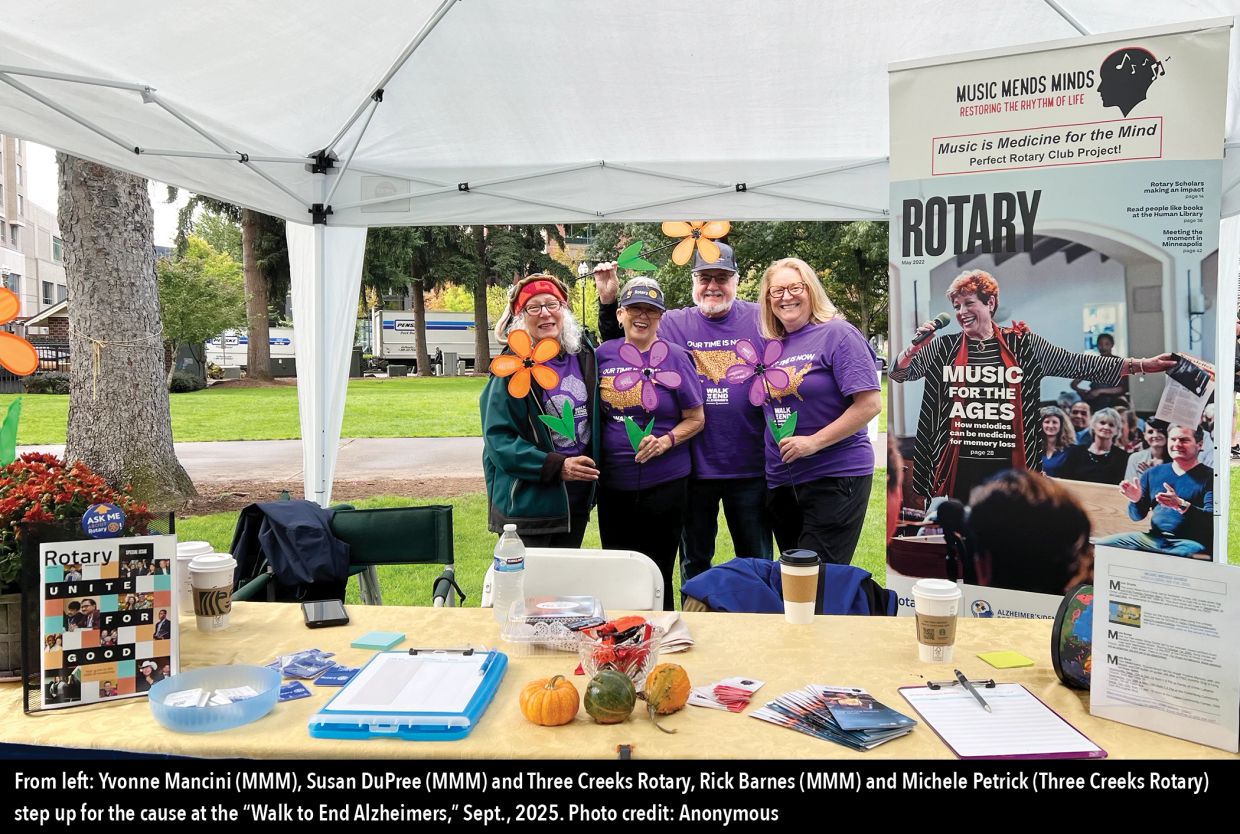
As well, drums purchased with a grant from the International Fellowship of Rotarian Musicians were used at a Southwest Washing-ton Alzheimer’s Association’s Annual Walk to End Alzheimer’s. MMM-Vancouver founder retired clinical psychologist Susan DuPree, PhD, secured crucial funding for the drums from her former Rotary Club in California.
In addition, Family of Christ Lutheran Church in Vancouver provided ADA-accessible space and in-kind support from inception for the drum circle. Beginning last year, the church opened its doors to accommodate a weekly song circle and then provided a grant to fund it. The circle is led by guitarist and Kelly Aloia of Vancouver-based Upbeat Music Therapy, with songbooks provided for participants. Online streaming options are slated to launch in the fall.
Extending its outreach in both the drum and song circles, MMM also welcomes adults with developmental disabilities, who face concurrent memory and wellness challenges.
Rounding out the chapter’s offerings is the Coyote Moon String Band, led by singer Yvonne Mancini. The band hosts monthly singalongs at Vancouver’s First-enburg and Luepke community centers, and provides specialized sessions upon request at local senior residences and assisted living and memory care facilities.
Looking to the future
While all groups are currently on summer break, they are preparing to return in September with several exciting initiatives on the horizon.
• Strategic alignment – MMM-Vancouver is aligning its programming with Hope Dementia, a division of CDM Caregiving.
• Trivia competition – Organizers are anticipating the upcoming national music trivia competition, sponsored by the parent organization (MMM-Los Angeles) and ADRAG (The Alzheimer’s and Dementia Rotary Action Group). The grand prize is a trip to Hawaii.
• Second band – The chapter is looking for musicians to make up a small band in Salmon Creek/Felida.
• Funding opportunities – The chapter welcomes financial partnerships with organizations, clubs and individuals passionate about addressing local public health, disability and eldercare crises.
Get involved!
To help bring joy through music and restore the rhythm of life, please contact Executive Director Susan DuPree at WA4MMM@ gmail.com or 925-998-9007.
Stephanie Haslett is a staff volunteer with MMM Vancouver. She brings her skills as a former activity director for senior facilities with an enduring interest in music for seniors.
Dr. Jim Moody is a retired social scientist and member of the border of directors for MMM Vancouver as well as a founding member and guitarist in the COYOTE MOON band.
Dr. Susan DuPree is a retired Clinical Psychologist and founder and executive Director of MMM-V.